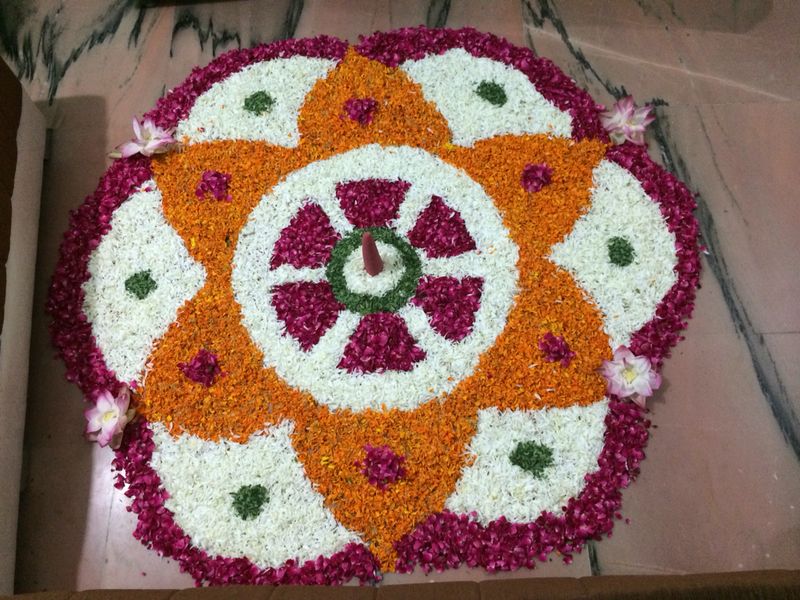
Today is Onam (‘n’ as in ‘money’). Kerala’s festival. Kerala (‘keralam’ locally), is the southernmost state of India, on the south-western tip on the ‘Malabar Coast’ of the Indian sub-continent. With a lush green terrain, full of coconut trees, paddy fields, backwaters and a number of rivers flowing west towards the Arabian Sea, the geography is fondly called the ‘God’s own country’. At least that’s what one would feel when looking down from an airplane while landing at the ‘Nedumbassery’ airport of Cochin. First impressions can quickly change when the plane lands on the ground and one starts getting a ‘real life feel’ of the life on the ground! Cochin is the business city of Kerala, and Trivandrum is its Capital. People of Kerala are known as ‘Malayalees’, going by the name of the language ‘Malayalam’ they speak. ‘Malayalam’ is a proto-Dravidian language but has 85% of its words originating in Sanskrit (“Saṃskṛtam”).
Onam has a story. The story of the Hindu god Vishnu taking the shape (Avtar) of a dwarf to test the benevolence of his devotee king Mahabali who people in Kerala believe used to be their king. Though a demon king from the Asur dynasty, Mahabali was God-like. People were happy in his kingdom. There was equality, no theft, no cheating, no one lied, no one made false promises, and people lived without fear in an ideal society – in short, just everything opposite of what politicians do to India today! That made Indra, the king of Gods jealous. He felt if a demon king becomes so godly, and if people start worshipping him, it will erode the authority of Gods. So, being the true politician he is, he went to Vishnu the supreme God of conservation and pleaded him to do something about this and restore the authority of Gods! Vishnu was reluctant because he was fond of King Mahabali. Eventually he agreed, took the form of a three-feet tall dwarf human and appeared before Mahabali in his court. This ‘avtar’ of Vishnu is known as ‘Vaaman’, one of the 10 avtars of Vishnu. Mahabali, the benevolent king he is, wouldn’t disappoint anyone who seeks his help. Knowing that Vishnu asked him for a 3-feet long piece of land in his country. Mahabali, by then understood who he was, but wholeheartedly agreed to Vaaman’s demand. Vishnu then got back into his real form, and with one step covered the earth (Bhumi), the next step the heaven (Swarg) and not seeing any land left to set his foot for the third step, he looked at Mahabali, who then bowed before him and gestured him to put his foot on his head. Vishnu did that and Mahabali got pushed down to the world of Asurs. Feeling bad, he then offered him a reprieve. He could visit his people for 10 days every year. This visit, according to mythical beliefs, happens on the Tiruvonam day (the 10th day of the Onam celebrations). Onam, thus marks the commemoration of Vaman avtar of Vishnu, and the celebration of Mahabali’s yearly return to see his land of prosperity and prosperous people. (Now what he sees is a bunch of over drunk Malayalees standing in long queues in front of liquor shops under the close watch of Kerala Police!)
Onam is a rice harvest festival. It is celebrated right after the Monsoon rains, in the months of August-September. Like most other Indian festivals, Onam too is a festival with its agrarian origins. It is a festival of flowers and food. The 10 day celebrations start on the ‘atham’ (hastha in Sanskrit calendar, followed by Chithira (Chaitra) Chothi (Swati), Vishakham (Vishaakha), Anizham (Anuraadha), Trikketta (Jyeshta), Moolam (Moola), Pooradam (Poorvashaada), Utradam (Utrashaada), and Tiruvonam which is shraavan. A floral decoration in the courtyard marks the beginning of the 10 days festivities. It is called ‘pookalam’. Right in the middle of the pookalam, a clay-made deity is placed. The flower decoration is in fact a way of worshipping this deity. But, Onam being a festival of fun, no one really cares about the religious aspects of it. And it should be that way. That makes it a people’s festival. As days pass and gets closer to the 10th day, the floral decoration will become bigger and better with nicer designs and more colors.
A little bit of nostalgia. All the more thinking about Onam today from Vancouver in British Columbia!
Growing up in a Kerala village, Onam meant everything fun during my childhood. Starting with a 10 days school holidays, a bunch of us, school friends, used to get together and wander around the fields plucking flowers. It is spring in Kerala in August-September and a variety of flowering herbs used to offer us an amazing collection of flowers. We will get back home and arrange them in flower bags (poovatti) hand-made bags (made of the dried leaves of Screw Pine Palms (Pandanus) and “kaita” in Malayalam). With clay, we would have made ‘onathappan’ the little sculptures (apparently the deity) and got it dried under the sun and shaped up nicely by then. On the night of the 9th day is ‘Poomattam’, a ritual of inviting both the God ‘Vaman’ and the God-like king ‘Mahabali’ from the courtyard into the sanctum sanctorum of the home with lights and flowers made into a long stretch of floral decoration across the courtyard. What follows is a day full of fun, food and festive fervor.
Happy Onam!
A footnote on Kerala:
Kerala has approximately 33 million people – a land of some intriguing paradoxes. Look at some of these data points: Kerala has the lowest population growth rate in India, the highest literacy rate (above 93%), the highest Human Development Index (HDI) of all the Indian states, the lowest homicide rate, the highest life expectancy and according to Transparency International, among the least corrupt states in India. All facts that should make Malayalees very proud. But, now here is the other side of the story:
Kerala has the highest per capita alcohol consumption in India. It is more than 8 liters of alcohol per person yearly. The state reports the largest number of alcohol addiction cases with all its hospitals and rehabilitation centers full! Kerala has the country’s highest unemployment rate at 7.4% way above the national average of 2.3%. Lots of job-less people. So, the myth of Onam becomes all the more important for today’s ‘Alcoholic Synonymous (as opposed to Anonymous) Kerala’!
With the State Government of Kerala now proposing a complete prohibition of alcohol, next year either Mahabali will see no drunkards in Kerala, or he will have to go elsewhere to see Malayalees! Let’s wait!
 Mind, Matter & Musings
Correct presentation of malayalies Onam of today in the bakdrop of past memories