It was just another business lunch on a Friday, at the McCormick & Schmick’s in Bellevue, Seattle. Half way into the lunch, some left for another meeting. Those of us remained agreed for a shot of single malt. After all, it was a Friday afternoon. (And I am going to talk about Gandhi!) I wanted some time with Marty. So, he and I stayed on for a round of coffee. June, the server, took good care of us. Sipping coffee, Marty spoke about the time he spent in India with his family. He paused momentarily, took another sip of coffee and said: ‘hey, I want to tell you something interesting that recently happened with Isabelle’. Marty was referring to his daughter Isabelle. Isabelle was in middle school when she came to India. The first time I met her was in Kumarakom. On a house boat. I had invited Marty and his family for a boat ride at the Punnamada resort. Relocating to India with three young kids can be really overwhelming for an American family. I was surprised that they were more than happy to be in Delhi. I found in Hannah, the eldest among them, an unusual individual. She was way ahead of her age in her thinking and expression. Isabelle was shy, quiet, and self-absorbed. Emmelt, the youngest was just playful. We played some table tennis (Ping Pong for the Americans) together. They relocated to the United States after spending 4 years in India. In late 2012, I met Isabelle again. By now, she had grown up into an young, energetic college student. She brought with her a friend from Iceland who she met in Italy during a student exchange program. We met at an Italian place at Delhi’s Houzkhas village. A nice evening. Memories zoomed past me as I listened to Marty
‘Isabelle was attending this talk program at her college. The talk was about Gandhi. During the open floor, the speaker asked around the students about their thoughts on Gandhi. Isabelle stood up and spoke about Gandhi. And it was well received. When the program got over, one of her classmates, an African American student, came to her and said, ‘hey Isabelle did you realize something? You spoke well, and interestingly you spoke in first person as in ‘WE’ whenever you referred to India’. Isabelle was surprised at that comment. Trying to recollect her talk, she realized she was indeed speaking in first person as in ‘we in India.. or when we think of Gandhi, this is what we feel about him’ and the like.’ Marty paused. Now both of us are quiet. A moment of truth for me, as much it is for Marty.
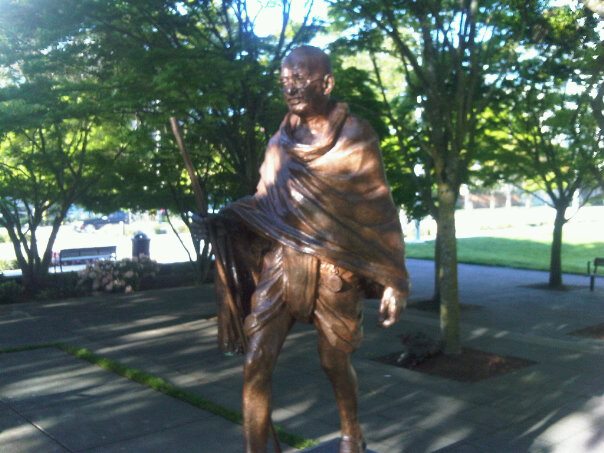
I am an Indian living in times when we debate the relevance of Gandhi. And I sit in Bellevue, next door to an American business that hugely influenced this world, at an American restaurant, listening to an American about an American college student identifying herself with Gandhi, India and the values of the man and a nation he put together from out of 600 odd small kingdoms that had surrendered to British sovereignty. Probably for Isabelle, the 4 years she spent in India has become all the more relevant and personal as she moves on to become a university student in the US, and as she spends time elsewhere, in Italy, in Europe. Is that because Gandhi is becoming more relevant to the world, and less relevant for India?. Less than a mile away from where I sit, in front of the Bellevue public library, there is a statue of Mahatma Gandhi. The plaque at the bottom reads ‘contributed by Microsoft’. Is Gandhi, the man and his message, relevant in a world of ISIS beheading innocent civilians, a hugely polarized Arab world on the brink of another war (whatever you call it – war, “special operations”, whatever the US State Department attempts, and painfully so, to characterize it..), Africa struggling with Ebola virus killing children across that continent, in a world of multiple nuclear flashpoints – Gandhi’s India has its own Kashmir!, North-South Korea, and most recently Vladimir Putin reminding the European Union that Russia is a nuclear power!
Gandhi was a seeker of Truth. His life itself was an experiment with truth. Coincidentally, a week ago, I had started reading again his autobiography. Every time you go back and read Gandhi, it gives you a new perspective. That could be true for every book that you read again. Your own experience shaping your reading of the same book differently as your thoughts evolve and perspectives solidify. Gandhi’s early experiments were mainly with celibacy and vegetarianism. Born Hindu, into a strictly vegetarian family, Gandhi breached the orthodoxy of his family when he ate meat in the companionship of a school friend. He confessed that to his father expecting a violent reaction from him. His father didn’t react at all. He listened to Gandhi quietly. His eyes welled up. That quiet pain in him left an indelible impression in Gandhi. Then in London, and elsewhere he got closer to having physical relationships with women. Sins, confessions and purifications, that early in life made him unusually pure. He experimented with truth. It is that purity of soul, that probably gave him the moral authority to think up and practice his most important political philosophy: non-violent disobedience. If leadership is the ability to influence both thoughts and emotions of the people around you, then Gandhi epitomized that. Of course, he, like the other great men who were influenced by his thinking, Martin Luther King and Nelson Mandela, had a significantly emotive cause to galvanize people around him and create a people’s movement. There is this interesting frame (scene) in Richard Attenborough’s film Gandhi. Two American journalists visit him. Obviously they wanted something sensational to write about. If I remember correctly, the scene shows Gandhi telling the young journalists on an evening to wait until the next day for something interesting. The human side of Mahatma. And the next day he started the Dandi march leading to the salt satyagraha against the British imposing a tax on common salt. Over 60,000 people made salt from sea water defying a Government rule that prohibited people from making it. Almost all of them were arrested. That according to Gandhi was ‘civil disobedience’. He believed it is justifiable to breach a law if the law itself is ‘immoral’. (Morality of Law!, a deeper philosophical issue there, who wrote that book; Lon L. Fuller is it?!). Non-violence as a political movement didn’t find favor with a large section of people in the Indian National Congress initially. It took time even for Gandhi to find enough supporters within the Congress. But overtime, Gandhi was able to convert his life itself into a message – and that made him Mahatma (the enlightened soul). Something that made Albert Einstein remark that coming generations will scarce believe that such a man as this one ever in flesh and blood walked upon this Earth.
Isabelle is from that generation that Albert Einstein was prophetically referring to. But she and many others of her generation remember him. Not just remember, they believe in the message the man lived and left behind.
 Mind, Matter & Musings