“Are you from Eritrea?”, I asked the cab driver who picked me up from Union Station. I had arrived in Washington DC a few minutes ago by an Amtrak train from New York City. Mine was a wild guess. If you happened to have an African American cab driver in DC, Manhattan or Seattle, if he is in his 50s, take a chance and ask – they will be either from Ethiopia or Eritrea! And they would have most likely migrated to the United States in their early 20s, right after their school and roughly 20 plus years in the States and most of that as a cab driver. So, I got it right, this time again. He was from Eritrea – a ‘consequential stranger’ for me for another 15 minutes until we cross Potomac and up until we get to Pennsylvania Avenue to the hotel that is my home for the day.
So, do you like ‘Injera’? My next. Now he is all smiles. Of course he does. And I knew he would. It is his national dish. And I get another download on “Injera”, made of teff flour, a sourdough-risen flatbread made on a pan. As he concludes, and a few moments of quietness later, here comes the next, from him. ‘You from India’? As I say yes, the next most predictable topic happens: ‘Bollywood’. He has watched ‘Mother India’ when he was a school boy.

Injera (above) is made of teff, a grain with a lot of iron content. It is a relatively expensive grain compared to wheat, barley or corn. It is mostly grown in the higher regions in Ethiopia with significant rainfall. Injera is made of fermented teff. Teff flour is mixed with water and allowed to ferment overnight and the dough is then used to make pancakes. ‘Appam’ from Kerala is very similar to Injera.
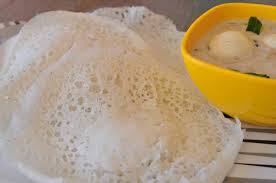
Appam is made of rice batter. Fermented using either yeast or coconut water. It is a pancake. The bottom portion that touches the hot pan will be crispier than the top which due to the fermented flour become porous. In fact the chef would pour the dough into the hot pan, lift up the pan and swirl it around to get the flour spread around its center to make the edges somewhat similar to the French crêpe. So, Appam is crisp on the edges and soft and thicker in the middle. Appam combines with a variety of ‘curries’, chicken stew being the most popular. Indonesian and Burmese cuisines have a variant of Appam.
By now, we are at the foyer of my hotel. It was a short drive across the Potomac waiting for the cherry trees to blossom again.
 Mind, Matter & Musings
Nice Manoj!! was interesting…..aur Appam look alike…..taste alike???..injera!!.u could really kind of write a book on your travel chronicles!!!!!!