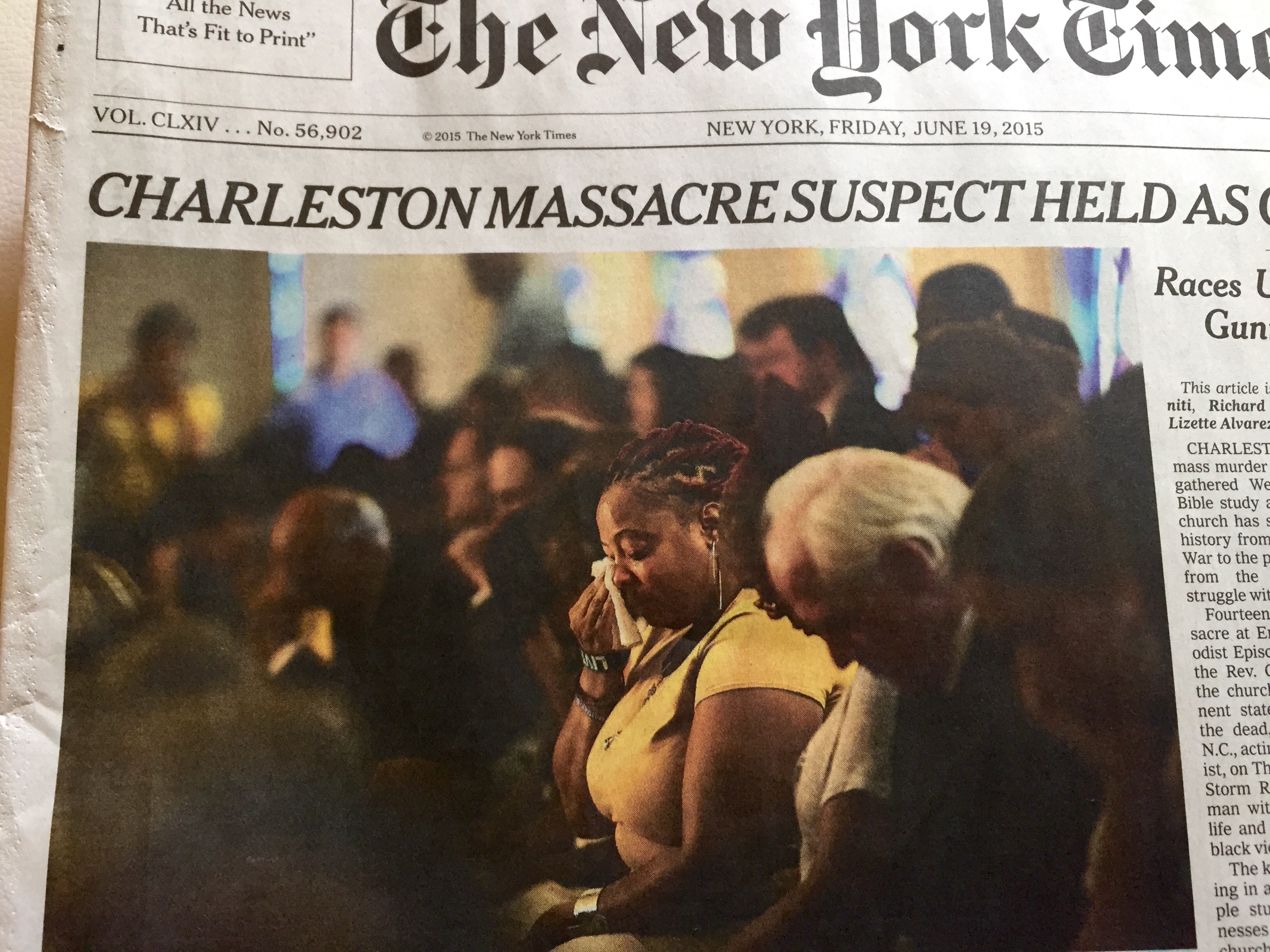
This weekend America woke up grieving the mass murder of nine people at a black church in Charleston, South Carolina (SC). They had gathered for a Bible study. Police arrested a white, boyish-looking, 22 year old male suspect. Newspapers carried reports of a gruesome hate-crime reflecting the racial fault-lines of United States. The suspect used a semi-automatic gun allegedly gifted by his father on his birthday, prompting President Obama to call for gun-control –America’s sensitive political issue. Extensive reports of the Charleston massacre, both in national newspapers and TV news channels made me reflect on ‘race as we live it in India’.
Indians normally live caste, and a lot less race and racism. I had my first tryst with race when I relocated to New Delhi. I never knew there existed a word called ‘madrasi’ until I arrived in Delhi for work. Back in Cochin, raised as a ‘mallu’ boy in Travancore, Madras was far removed from our lives. Different in respect of language, cuisine – we eat a lot of fish, festivals – we celebrate Onam, weather – it rains all the time in Kerala, I grew up thinking I am a central Travancore ‘Malayali’. A sense of caste, despite all the education, refinement and civility, is way too deep in Kerala’s social psyche. Born ‘upper caste’ Nair, with a ‘Pillai’ title apparently gifted by the Travancore king, my family’s lineage had people with all kinds of surnames – my mother’s father was a Kurup, my father’s father was a Pillai, some relatives are Menon. Mother’s grandfather was a Namboodiri, then some Unnithan’s, Panickers.. all sorts of titles and surnames within the caste – Nair. So, very early in my childhood I understood the social implications of being born Nair. And soon, I learnt that some of my uncles have been fighting against caste divisions in our community and my home is a lot progressive. So, I grew up knowing ‘caste’ but not living caste. And there comes my first encounter with race – I was a ‘madrasi’ in Delhi!
I was actually amused in the beginning. ‘Madrasi’ is a sweeping racial generalization for everyone from south of India for those in the North. Soon, and as I started ‘living life the Delhi way’, I realized there exist more races, more racisms and a whole lot of racial profiling. Punjabis, Biharis, Bengalis and then a whole different way of racially profiling people from the North-East of India. They face the worst situation as they ‘look different’. God!
When I got married to someone from Bihar, I would say my wife is a ‘Bihari’. To me that just meant she is from Bihar. Someone from Kerala is a ‘Malayalee’ just as someone from Bihar is a ‘Bihari’. On several occasions, a typical Delhi-ite would give me a strange smile when I would say, yup, my wife is a ‘Bihari’. Then I realized ‘Bihari’ for Delhites is a casual laborer. After ‘madrasi’ this was my second tryst with racial stereotyping. Bihar to me is the land of ‘Maurya’ empire, the seat of the celebrated ancient university ‘Nalanda’, the land where the first republican state ‘Lachchvi’ was experimented, the land of enlightenment of Buddha, the land of Ashoka, for many decades Patna University’s history department was among the best in Asia. In modern times, Bihar produced the largest number of civil servants in India. So, how can ‘Bihari’ be racially profiled as a down-trodden laborer, I didn’t understand.
If someone asks your name in India, and if you just say, I am Manoj, your first name, the answer is totally incomplete for an Indian. Seeing the sense of incompleteness on the questioner’s face, you would end up saying your full name. The person will be relieved as it would “reveal” to him/her a whole lot of things:
- Which part of Indian you come from!
- Your race!
- Your caste!
- What type of person you can be: a Bengali gentleman will presumably be obedient to his wife!, a south Indian will be the right choice to rent an apartment in Delhi – he/she will vacate the house without offering a fight!, some Indian surnames presumably reflect people with sharp sense of business – this stereotyping is an amazing topic probably for a social psychologist to research on and write a about!
My friend Marty once said to me this story: Someone in India asked him what’s his name. He said, Marty – Martin Shively. The guy persisted. He wanted to know what Shively means. What does it imply? Marty said that’s my dad’s surname, he was an engineer, that’s all that it means! The Indian gentleman was totally disappointed.
Recently, I was in a car with my friend PH Kurian (PHK) in Bangalore. We were on our way to the airport after attending a stellar 25th anniversary of Strides. PHK is a student of religious history, among many other topics including IP – after his stint as India’s Controller General of IP. So, I once again asked him a few questions on the history of Christianity in India. As I listened to him, I realized one thing. Even Christianity in India has caste underpinnings. The edifice of Church in the Indian context is constructed on the sub-text of caste system. Back in Delhi, I explained this to my colleague Steve Schott who is raised as Catholic in Buffalo, NY and who went to a Catholic school. He was amused – Biblical teachings and caste, what a paradox!.
America has come a long way from its history of slavery, of a civil war against it, and to the present of having elected an African American President. The Charleston massacre is a systemic aberration. America’s national spirit constructed on rock-solid foundational principles will not be dented by one odd, bad incident. It is India’s time now to get rid of its race-caste driven national social psyche. As Cricket, Bollywood, the IT industry, social media, and a variety of technologies stitch together India’s under 20 generation, and a collective sense of having to progress as a nation begins to set in (without of course destroying our environment any further) – we must re-integrate and re-define our country erasing race and caste from the nation’s DNA. We will.
Acknowledgment: Photograph of Travis Dove of New York Times
 Mind, Matter & Musings