A sudden spell of rains didn’t let us cross Allégatan, the main street of Borås, to walk across to the university building. So, we were delayed for a few minutes for our next meeting. But, Tomas Brandberg’s face didn’t show any displeasure, despite Swedish. A country and its people known for keeping to their time, impeccably. Meeting Tomas was to engage him as a consultant for the Scandinavia business in the making. A PhD in biotech from Chalmers, Tomas is basically a chemical engineer supervising doctoral students at the Borås University. But, from the first few moments of listening to him, I realised I was chatting with someone unusual. Instead of innovation, entrepreneurship and intellectual property, the usual suspects in those chats, with Tomas quickly the conversation turned to something intriguing. He is fluent in Russian and I asked how? He said he was a Russian interpreter in the Swedish Army and there began the intrigue. I was keen to know more about a sudden sense of geopolitical concern in Sweden about Russia’s recent military activism. That I realised is a contemporary topic among the Swedes.
Sweden’s last war with Russia led to the creation of Finland. Swedes probably still remember the bitterness of the Finnish War so closely that Russia’s recent action in Crimea makes them concerned. Having resisted the temptation to join NATO, and having remained a neutral country in the second World War and rather having made best use of the post-war industrial surge in the Europe, Sweden has been off late active militarily only with UN programs. So, when Crimea declared independence from Ukraine and sought to become part of the Russian Federation following a referendum in March this year, it had the backdrop of Russia’s military might. The very next day after that referendum’s results came out, President Putin officially announced the Black Sea peninsula as a part of the Russian territory. This is now making the Swedes realise that the focus of their military activism cannot be any more Afghanistan and it has to be elsewhere. And that made Tomas’s fluent Russian language expertise, and his role as a Russian interpreter all the more intriguing. So, I asked him what use his Russian language would have for a country which probably does not have any prisoner of war remaining alive from a war that they fought a few hundred years ago! He was reluctant to elaborate. Understandably. So, he quickly changed the topic to Mid-Summer Eve and what it means to the Swedish people.
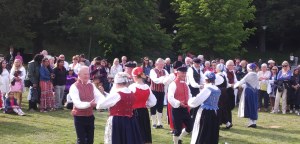
This Friday was the Midsummer’s Day. It is the longest day of the year, and the shortest night – the summer solstice. Back in the days of the Vikings, I listened intently as Tomas elaborated with his characteristic élan, it was about fertility with the Midsummer Pole making a phallic symbol, the symbol of fertility of the Mother Nature with people expecting better harvests in the coming year. The Pole’s symbol, Tomas felt, may have its origin in the Pagan god of Freyr, sometimes anglicised as Frey. Frey is a prominent God of Norse Paganism, the pre-Christian era of Scandinavia. Freyr in Norse Paganism is the God of prosperity, with sunshine and summer.
By now, both my fellow listeners Ram and Hitesh lost their patience. Tomas was keen to tell us more. But, they insisted that it has to be for another day. Glad midsommar!
- Comment
- Reblog
-
Subscribe
Subscribed
Already have a WordPress.com account? Log in now.
 Mind, Matter & Musings
Interesting!