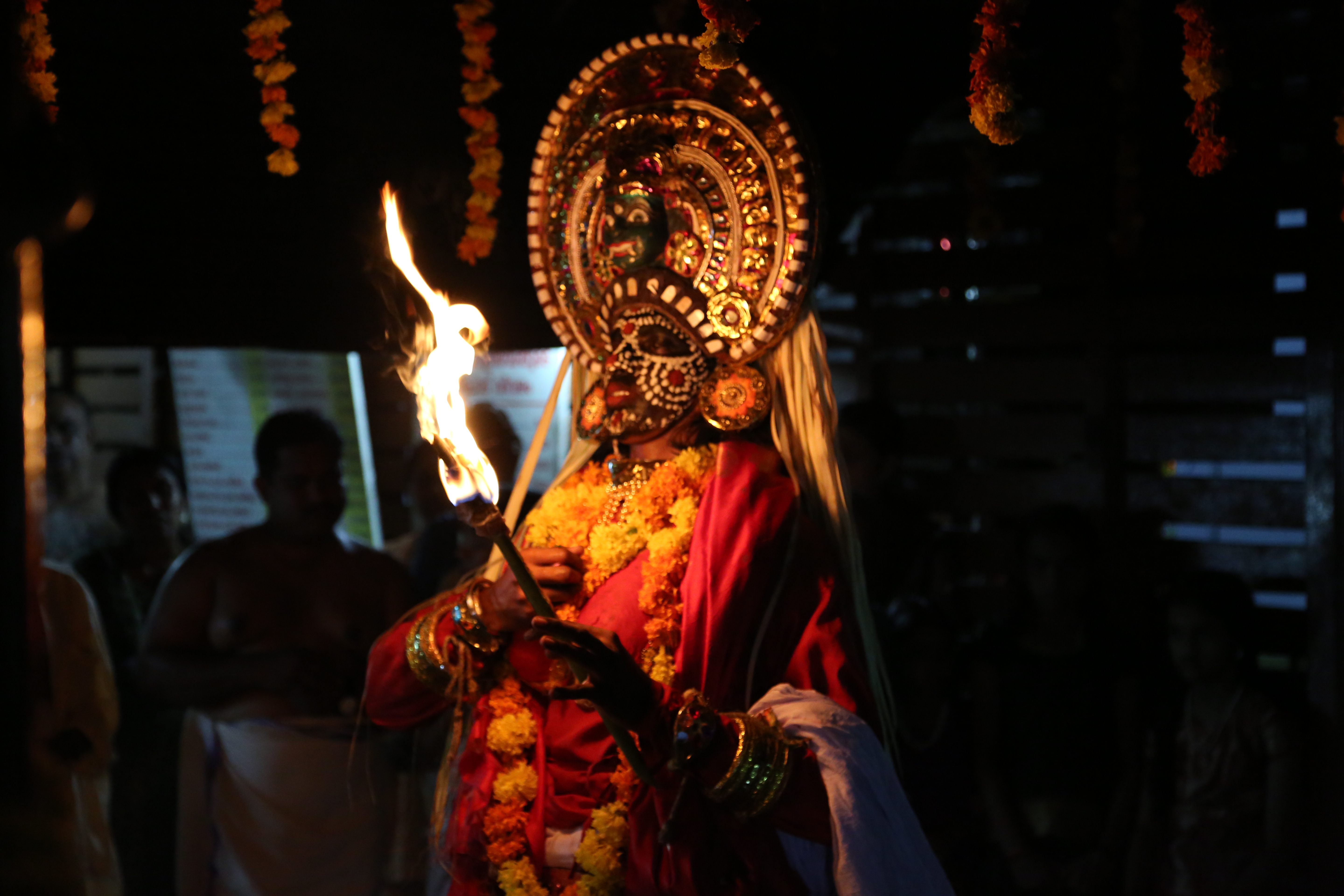
Matt Broke and Steve Schott had no idea how that Sunday evening would unfold when I got them to drive with me to my temple town of Vaikom in Kerala. Dressed in white kurtas and pajamas they looked ready for a cultural adventure. Matt’s Buddhist leanings, and Steve’s unending curiosity to know the world’s cultures made me invite them to our village temple. And that day, the temple had a theeyattu performance. That offered them probably an unusual, unadulterated cultural experience. And it was the first time I clicked away many intense visuals of “theeyattu”- a temple dance performance prevalent in the Central Travancore region of Kerala.
“Theeyattu” is a ritualistic temple art form of which the central character is the Hindu Goddess Bhadrakaali (Kaali or Durga), the widely worshipped deity of Kerala and Bengal regions of India. “Theeyattu” is a dance performance through which Kaali re-enacts and graphically tells her father Shiva how she killed the demon (“asur”) Daarika. Darika when he was young was an ardent devotee of Brahma, the Hindu God for Creation. He and his brother Danava performed a “yaaga” (an intense prayer worship) to please Brahma and sought from him a boon that no male could kill them. Brahma asked them why only a male to which they answered no woman would be able to resist their charms. That angered him. So, they got the boon, but also got a curse that a female will one day kill them. Darika and Danava and their woman associate Vasoori-mala, the lady who used to spreads small-pox, started killing people and even became a threat for the Gods. So, the Gods got together and prayed to Shiva the God of Destruction, to help the humanity by creating a lady Goddess who could kill the demons. Shiva asked Narada, the singer sage, to make a portrait of the lady Goddess – and Narada readily made a sketch of the Goddess using color powders. Shiva gave life to that sketch. Various gods gifted her their weapons. Shiva blesses her to become fiercely powerful and to have the courage to kill Darika. She would eventually kill Darika over a fierce fight and return victorious to tell that story to her father. Thus Kaali became the epitome of femaleness, the ultimate power of woman.
“Theeyattu” is performed in front of the deity inside the courtyard of the Kaali temples, mostly during late evenings. The natural yellow flames of oil lamps, the surrounding darkness, the temple courtyard, the rage of drums, the “theeyattu pattu” (the battle song) and to top it all the performer’s bright red dresses and the head-gear – all of it makes theeyattu an extremely intense performance. A large oil lamp, “theeyattu vilakku”, gets placed right in front of the courtyard. The belief is that the oil lamp is Shiva. The performer (“theeyattu unni”) would mostly sit with her back facing Shiva. Because she got infected with small-pox during her battle, she doesn’t want Shiva to see her scarred face. Whenever she needs to face him, she will use a piece of cloth to cover her face. And towards the end of the performance, she would get raged depicting how she killed daarika, and at that point she would show her face to Shiva and show how angry she was. A few moments later she calms down and bow before her father. With that theeyattu would end.
Theeyattu is performed by the male members of a community namely “theeyatt unni”. A variant of the Travancore style “theeyattu” is prevalent in Northern Kerala called “Ayyappan Theeyattu” performed by “thiyyadi nambiars”. At Moothedathu Kavu temple, “theeyattu” is performed by the family of the well-read, well-spoken and handsome Shashidhara Sharma. He once mentioned to me that UNESCO has enlisted “theeyattu” and its more detailed version of “mudiyettu” as an Intangible Cultural Heritage. UNESCO’s Representative List of the Intangible Cultural Heritage of Humanity does include “Mudiyettu”. Interestingly, the Sanskrit theatre performance of “kutiyattam” tops the list from India along with “Ramlila”, the traditional Ramayana performance, “Kalbelia”, the folk songs of Rajasthan, “Chhau” dance of Eastern India, “Ramman” from the Garhwal region, Ladakh’s Buddhist chanting and “Mudiyettu”, the longer variant of “theeyattu”.
So, thank you Steve and Matt for a wonderful evening and prompting me to write about something I grow up seeing, year after year.
 Mind, Matter & Musings
Wow! interesting Manoj…..it reminds me of the Pava Kooth festival…held at Payallur Puratiyal Bhagawathi Temple at in-laws place….Palakkad!!